
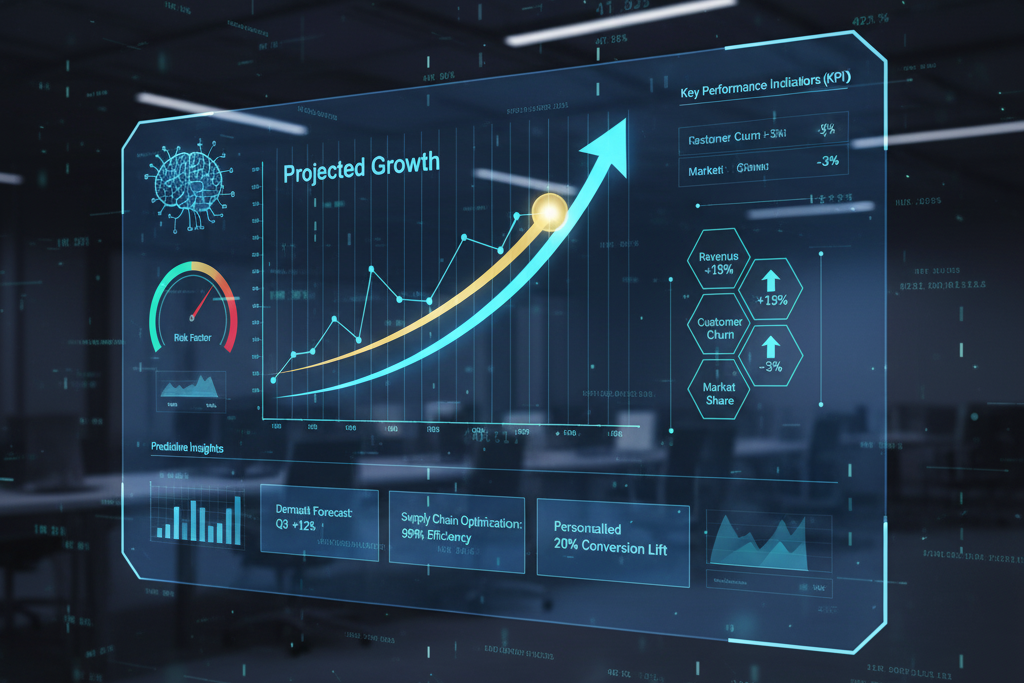
In a data-rich world, AI Predictive Analytics for Business is the strategic advantage companies use to turn the future from a gamble into an informed projection. From forecasting demand and minimizing risk to optimizing operations and personalizing customer experiences, predictive analytics driven by artificial intelligence (AI) is dramatically altering how decisions are made. This article explains what predictive analytics is, how AI strengthens forecasting, business benefits and use cases, ethical considerations, and a pragmatic implementation roadmap. With AI Predictive Analytics for Business, companies can transform massive datasets into accurate forecasts that guide smarter decisions across markets and operations.
Why AI Predictive Analytics for Business Matters Today
Organizations face accelerating complexity: volatile markets, shifting consumer behavior, and increasingly linked supply chains. Traditional decision-making—based on intuition and retrospective reports—can be too slow. AI Predictive analytics for Business uses historical and real-time data with statistical and AI models to estimate what is likely to happen next, enabling proactive strategies.
AI extends traditional analytics by detecting subtle patterns across millions of data points, incorporating unstructured inputs like text and images, and continuously learning as conditions change. The result: more accurate forecasts and faster, actionable intelligence for leaders at every level. For leaders navigating uncertainty, AI Predictive Analytics for Business provides the clarity to act decisively before market shifts occur
How AI Predictive Analytics Forecasts Market & Operational Trends: core techniques
AI predictive systems combine multiple technologies to forecast with higher accuracy:
- Machine Learning (ML) models (regression, decision trees, gradient boosting) that learn relationships between variables.
- Deep Learning for complex patterns and multimodal data (images, text, audio).
- Time-Series Models (ARIMA, Prophet, LSTM networks) optimized for temporal forecasting.
- Ensemble Methods that blend models to reduce variance and bias.
- Feature Engineering & Automated ML (AutoML) to surface the most predictive variables from raw data.
These technologies together form the backbone of AI Predictive Analytics for Business, ensuring every forecast adapts to dynamic market signals.
Where classical statistics require careful manual feature selection, AI techniques can process high-dimensional data and discover non-linear relationships that matter to forecasting.
Key Business Benefits of AI Predictive Analytics for Business
The practical value of AI predictive analytics for Business spans nearly every corporate function:
- Demand Forecasting & Inventory Optimization. Predict future sales volumes by SKU, season, and channel—reducing stockouts and excess inventory.
- Churn Prediction & Customer Retention. Identify customers at risk of leaving and target high-value retention offers.
- Predictive Maintenance. Forecast equipment failures to schedule maintenance proactively and avoid costly downtime.
- Fraud Detection & Risk Management. Spot anomalous transactions before losses occur.
- Dynamic Pricing & Revenue Management. Adjust prices in near real-time using demand signals, competitor actions, and inventory levels.
- Workforce & Capacity Planning. Align staffing or production capacity with expected demand to control costs.
When deployed effectively, AI Predictive Analytics for Business helps organizations translate raw data into measurable financial outcomes
These benefits are realized when analytics are integrated into decision workflows—e.g., automated reorder triggers, targeted marketing campaigns, or executive dashboards.
AI Predictive Analytics for Business in Action: Real-World Use Cases
Retail & E-commerce: Advanced forecasting can predict the uplift from promotions, identify trending SKUs, and personalize offers. Retailers can reduce markdowns and improve gross margins by aligning inventory with AI forecasts. See a case example in our.
Manufacturing & Logistics: Using sensor telemetry and scheduling data, AI models predict machine failures and logistic delays, enabling preventive action and faster customer fulfillment.
Financial Services: Lenders use AI predictive models for credit risk scoring and early fraud detection. Portfolio managers use forecasts to rebalance holdings and manage exposure.
Healthcare: Predictive models help hospitals forecast bed demand, anticipate outbreaks, and identify patients at risk of readmission—improving patient outcomes while controlling costs.
Agriculture & Food Supply Chain: Weather, yield, and demand predictions help producers optimize planting, harvesting, and distribution windows—reducing waste and improving margins.
Across industries, AI Predictive Analytics for Business supports better forecasting, improved customer targeting, and proactive operations.
For further reading on business applications and research insights, consider resources like IBM’s predictive analytics pages and McKinsey’s analytics research. (See outbound links at the end.)
Key data inputs for accurate forecasting
High-quality forecasts start with the right data:
- Historical transactional & operational data (sales, inventory, CRM records).
- External signals (economic indicators, competitor pricing, weather).
- Behavioral data (web analytics, customer engagement, clickstreams).
- IoT & sensor data for equipment and supply chain monitoring.
- Unstructured text & social signals (news, reviews, social media sentiment).
Robust, well-structured data ensures AI Predictive Analytics for Business models achieve consistent accuracy and real-world reliability.
Feature engineering—creating informative variables that represent business realities—is often the most important step. For example, encoding holiday calendars, promotional flags, and lead times dramatically improves demand forecasts.

Common challenges and how to overcome them
Data quality & integration. Bad or incomplete data will impair models. Implement data governance and a single source of truth. Start with a focused dataset and expand.
Model drift & changing environments. Markets evolve. Use continuous monitoring and scheduled retraining; include model performance alerts and backtest results.
Interpretability & trust. Business stakeholders need to understand model outputs. Use explainable AI techniques—local explanations (LIME/SHAP), model cards, and clear visualizations.
Compliance & privacy. Respect privacy regulations (GDPR, CCPA) and anonymize sensitive attributes where possible. Document data sources and retention policies.
Skills & infrastructure. Not every company needs a large data science team. Use cloud-based AutoML, managed data platforms, and partner with consultants for rapid pilots.
Implementing AI Predictive Analytics for Business at scale requires addressing several practical and organizational challenges.
Implementation roadmap: from pilot to production
- Define a measurable business use case. Start with a high-impact, narrow problem—e.g., reduce stockouts by X% or cut maintenance downtime by Y%.
- Collect & audit data. Identify sources, perform quality checks, and set data governance standards.
- Feature engineering & baseline model. Build a simple baseline model to set expectations.
- Iterate & validate. Improve features and model architecture, use cross-validation, and test results in realistic conditions.
- Integrate into workflows. Hook predictions into operational systems (ERP, CRM, order management) with clear action rules.
- Monitor & maintain. Track performance metrics, data drift, and business impact; set retraining schedules.
- Scale & govern. Move from pilot to multiple use cases, standardize pipelines, and formalize ethical review processes.
- A structured roadmap ensures AI Predictive Analytics for Business initiatives progress from pilot to production effectively.
Measuring ROI and business impact
Link model outputs to key performance indicators (KPIs): revenue uplift, cost savings, reduction in stockouts, mean time between failures (MTBF), and customer lifetime value. Use A/B tests and staggered rollouts to isolate the effect of AI interventions. These metrics help confirm that AI Predictive Analytics for Business contributes directly to operational and financial performance.
Ethical considerations & fairness
Predictive models can inadvertently encode historical bias. Ensure fairness reviews, demographic parity checks where relevant, and human oversight for high-impact decisions. Maintain transparent documentation and a clear escalation path for decisions influenced by models. Ethical governance is a critical part of sustaining trust in AI Predictive Analytics for Business applications.
Future trends to watch
- Explainable AI (XAI) will become the norm as regulators and stakeholders require transparency.
- Multimodal models will pull together text, images, and time series for richer forecasts.
- Emerging trends such as explainable AI and edge computing will redefine how AI Predictive Analytics for Business delivers value.
- Real-time forecasting & edge AI will enable instant pricing and operational decisions.
- AutoML and democratization will allow business users to prototype models faster, with data scientists supervising production systems.
Conclusion
AI Predictive Analytics for Business is not a single tool but a capability: a set of data practices, models, systems, and governance that together let organizations see the future more clearly. When planned around clear use cases, built on clean data, and embedded into decision processes, AI forecasting becomes a reliable engine for growth, resilience, and smarter operations.
“Harness the Power of AI to See What’s Coming Next”
In an age where data is the foundation of strategic advantage, adopting AI Predictive Analytics for Business is no longer optional—it’s essential. Businesses that harness AI forecasting gain the ability to anticipate market shifts, make smarter decisions, and stay resilient in a volatile landscape. Begin with a focused, high-impact initiative, build trust through interpretability, and cultivate a data-driven culture to continuously evolve. In an age where data is the foundation of strategic advantage, adopting AI Predictive Analytics for Business is no longer optional—it’s essential.
Ready to transform your operations with AI-driven predictive insights?
Visit our Emerging Technology services and let Tiso Studio design a tailored predictive analytics solution that drives growth, reduces risk, and prepares your business for tomorrow.
FAQ’S
1. How does AI Predictive Analytics improve decision-making in real time?
AI Predictive Analytics processes both historical and live data to forecast future trends, enabling leaders to act before problems occur. By automating insights and surfacing risk early, it helps companies shift from reactive decision-making to proactive strategy execution.
2. Which industries benefit the most from AI Predictive Analytics for Business?
Industries such as retail, manufacturing, finance, healthcare, logistics, and energy see measurable gains from AI forecasting—through reduced downtime, smarter inventory allocation, real-time risk detection, and customer retention optimization.
3. What types of data are needed for accurate AI forecasting?
High-performing predictive models rely on a mix of structured and unstructured data: transaction history, web behavior, CRM records, IoT sensor streams, market signals, weather, and sentiment data. The richer the data, the more accurate the prediction.
4. How long does it take to implement AI Predictive Analytics in a business?
Most projects begin with a pilot phase lasting 6–10 weeks—focused on a single use case—before scaling across functions. With modern cloud platforms and AutoML tools, companies can see ROI much faster than with traditional analytics programs.
5. Is AI Predictive Analytics secure and compliant with privacy regulations?
Yes—when properly governed. Predictive analytics systems can anonymize sensitive data, apply access controls, and comply with GDPR/CCPA by design. Ethical oversight and explainable AI frameworks ensure transparency and trust across all stakeholders.




Recent Comments