
IoT in Retail: Smart Connectivity for Real-Time Insights
In the modern marketplace, IoT in Retail is no longer a futuristic concept—it’s a competitive necessity. By embedding connectivity and intelligence into every layer of the retail value chain, IoT (Internet of Things) solutions empower retailers to capture, analyze, and act on real-time insights. From inventory tracking and customer experience personalization to energy optimization and predictive maintenance, IoT in Retail is transforming operations and redefining how businesses engage customers.
This article explores the impact of IoT on retail ecosystems—covering its core technologies, real-world use cases, implementation roadmap, measurable benefits, and future trends shaping the next era of smart retail.
Why IoT in Retail Matters Today
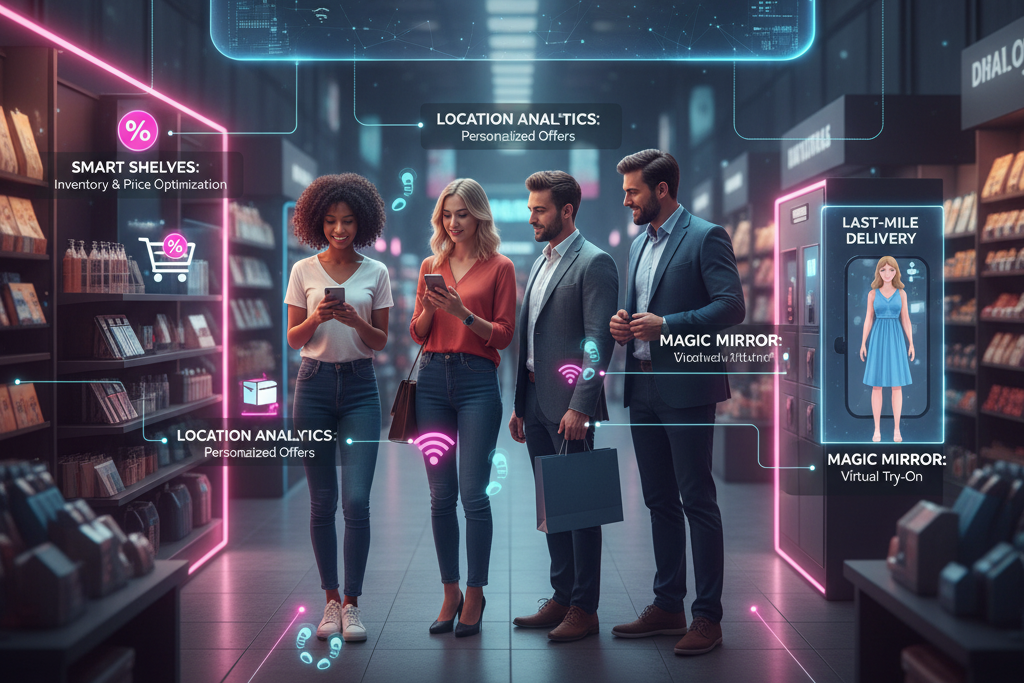
Retailers are under pressure to deliver seamless, data-driven experiences while optimizing margins. Traditional systems rely on static data and delayed reporting, leaving gaps between operational reality and strategic decisions. IoT in Retail bridges this gap by connecting devices, sensors, and systems into an intelligent network that continuously captures and analyzes information.
With IoT-driven analytics, store managers can monitor inventory in real time, marketing teams can deliver personalized offers, and executives can visualize performance across regions. The result? Faster decision-making, reduced waste, improved customer satisfaction, and higher profitability.
How IoT in Retail Enables Smart Connectivity and Transformation
At its core, IoT in Retail integrates hardware (sensors, beacons, cameras) with cloud-based analytics platforms and AI engines. Here’s how this smart connectivity delivers business value:
1. Real-Time Inventory Management
IoT sensors track shelf stock, warehouse inventory, and product movement. Retailers gain immediate visibility into stock levels and can automate replenishment based on predictive demand.
2. Enhanced Customer Experience
Smart shelves, beacons, and mobile apps deliver contextual promotions and product information to shoppers. With AI analytics, retailers can personalize experiences based on behavior, location, and preferences.
3. Predictive Maintenance
IoT-enabled equipment monitoring detects anomalies before breakdowns occur—ensuring uptime for point-of-sale systems, refrigeration units, and digital signage.
4. Energy Efficiency and Sustainability
Connected HVAC, lighting, and refrigeration systems optimize power usage in real time. IoT in Retail plays a crucial role in reducing carbon footprint and operational costs.Connected HVAC, lighting, and refrigeration systems optimize power usage in real time. IoT in Retail plays a crucial role in reducing carbon footprint and operational costs.
Learn more about sustainable tech innovation in IBM’s IoT Sustainability Insights.
5. Supply Chain Visibility
From manufacturing to last-mile delivery, IoT sensors provide end-to-end visibility—tracking shipments, monitoring conditions, and flagging delays before they impact customers.
Key Components of an IoT in Retail Ecosystem
Building a successful IoT in Retail infrastructure requires alignment across several technological layers:
- Edge Devices & Sensors: Collect real-time data from shelves, vehicles, and customer interactions.
- Connectivity Protocols: Wi-Fi 6, 5G, LPWAN, and Bluetooth Low Energy (BLE) ensure seamless data flow.
- IoT Platforms & Cloud Integration: Centralize device management, storage, and analytics.
- AI & Data Analytics: Transform raw data into predictive and prescriptive insights.
- Cybersecurity Framework: Protect customer data and prevent breaches in interconnected environments.
When orchestrated effectively, these elements create a smart ecosystem that responds dynamically to retail conditions.
IoT in Retail: Real-World Use Cases
1. Smart Stores
Retailers like Walmart and Amazon Go use IoT sensors and cameras to automate checkout, track inventory, and analyze shopper behavior. Smart shelves notify staff when stock runs low, improving availability and reducing human error.
2. Connected Supply Chains
IoT-enabled logistics systems track goods throughout their journey. Temperature sensors monitor perishables, while GPS trackers ensure on-time delivery—minimizing waste and improving transparency.
3. Personalized Shopping Journeys
Beacon technology sends personalized offers to shoppers’ smartphones as they move through a store. IoT data integrates with CRM systems to deliver hyper-targeted promotions.
4. Predictive Equipment Maintenance
Retailers monitor critical assets such as refrigeration units and POS systems in real time. Predictive analytics anticipate maintenance needs, avoiding costly downtime.
5. Omnichannel Integration
IoT bridges the online-offline divide. For example, when a customer orders online for in-store pickup, IoT sensors coordinate inventory updates and notify staff instantly.
The Business Benefits of IoT in Retail
| Category | Benefit |
|---|---|
| Operational Efficiency | Automated inventory tracking, reduced labor costs, optimized energy use |
| Customer Experience | Personalized engagement, reduced wait times, consistent omnichannel experience |
| Revenue Growth | Dynamic pricing, cross-selling recommendations, improved sales forecasting |
| Sustainability | Lower carbon footprint and resource waste through smart energy systems |
| Risk Management | Improved security monitoring and loss prevention |
According to a recent McKinsey report, retailers implementing IoT can achieve up to 20% improvement in operational efficiency and 10–15% cost reduction within the first year.
Implementation Roadmap: Building a Successful IoT in Retail Strategy
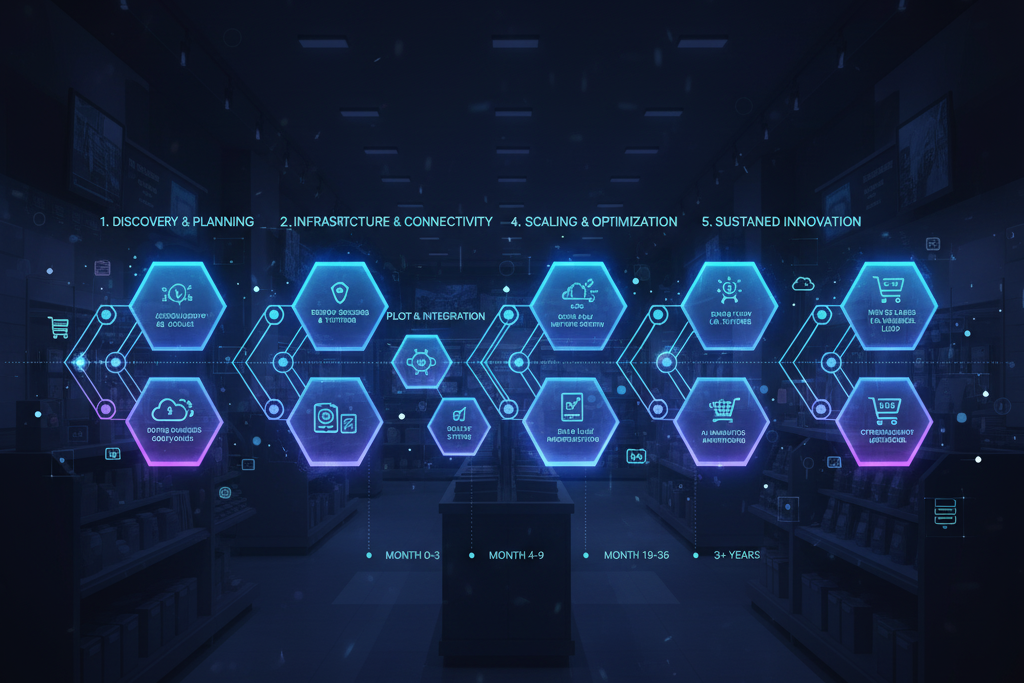
Step 1: Define Business Objectives
Identify measurable goals—such as improving customer retention, reducing shrinkage, or optimizing energy consumption.
Step 2: Assess Data Infrastructure
Audit existing systems to ensure readiness for IoT integration. Retailers often need to upgrade connectivity or cloud infrastructure.
Step 3: Pilot with a Focused Use Case
Start small—such as a smart shelf or connected refrigeration pilot—before scaling across multiple stores or regions.
Step 4: Integrate AI Analytics
Combine IoT data with AI-powered analytics to uncover hidden trends and optimize decisions.
Step 5: Ensure Security and Compliance
Implement strong data encryption, role-based access controls, and adherence to privacy regulations like GDPR and CCPA.
Step 6: Scale and Monitor
After successful pilots, deploy IoT solutions enterprise-wide and monitor KPIs such as ROI, uptime, and customer satisfaction.
Measuring ROI and Performance Metrics in IoT Retail Systems
Measuring the success of IoT in Retail initiatives requires tracking both financial and operational KPIs:
- Operational Efficiency Index: Time saved through automation.
- Customer Experience Score: Derived from dwell time, engagement, and satisfaction surveys.
- Inventory Accuracy Rate: Comparison of real-time IoT counts versus manual counts.
- Energy Savings Percentage: Power consumption before vs. after IoT implementation.
- Revenue Impact: Sales uplift from personalized recommendations and reduced stockouts.
Retailers leveraging IoT analytics platforms often report a 25–30% improvement in decision accuracy and 20% higher customer retention.
Common IoT in Retail Challenges and How to Overcome Them
- Data Overload:
IoT devices produce massive data streams. Overcome this by using cloud analytics and edge computing to process data efficiently. - Cybersecurity Risks:
Secure devices with encryption, two-factor authentication, and regular firmware updates. - Integration Complexity:
Legacy systems may not easily connect with IoT platforms—use APIs and middleware for seamless interoperability. - Scalability:
Begin with modular designs to scale solutions across multiple stores or markets without redesigning the architecture.
The Future of IoT in Retail: 2025 and Beyond
- Edge AI Integration: Real-time processing at the store level for instant insights.
- 5G-Enabled IoT Retail: Ultra-low latency for richer AR/VR shopping experiences.
- Digital Twins of Retail Stores: Virtual models for predictive simulations and layout optimization.
- Blockchain for Transparency: Securing supply chain and loyalty programs through immutable data.
- Sustainability Analytics: Using IoT to track carbon emissions and waste management performance.
According to Gartner, over 75% of retailers will adopt IoT-driven analytics by 2026, making smart connectivity a defining factor in competitive differentiation.
Conclusion: Turning Retail Data into Strategic Advantage
IoT in Retail is not just about connecting devices—it’s about connecting insights to action. Retailers that leverage IoT-enabled intelligence gain agility, precision, and deeper understanding of customer behavior. As 2025 approaches, the convergence of IoT, AI, and cloud analytics will define the next generation of retail excellence.
Transform Your Retail Vision with IoT Innovation
Ready to revolutionize your retail operations with IoT-driven intelligence?
Partner with Tiso Studio’s Emerging Technology team to design and deploy smart retail solutions that deliver real-time insights, optimize performance, and enhance customer experience.
Let’s build the future of intelligent retail—together.
FAQ’S
1. How does IoT reduce operational costs for retailers?
IoT helps automate inventory tracking, energy usage, equipment monitoring, and supply chain visibility. This reduces manual labor, prevents stockouts or overstocking, minimizes equipment failures, and optimizes energy consumption — all of which directly cut operational costs.
2. Can small and mid-size retail businesses adopt IoT, or is it only for large enterprises?
IoT adoption is highly scalable. SMBs can start with low-cost smart sensors for inventory tracking or energy monitoring before expanding into advanced analytics. Cloud-based IoT platforms now make enterprise-grade technology accessible at a smaller investment.
3. What role does IoT play in enhancing customer personalization in retail?
IoT devices such as beacons, smart shelves, and mobile apps collect real-time behavioral and location-based data. This enables highly personalized offers, dynamic pricing, product recommendations, and tailored in-store experiences that improve both engagement and conversion.
4. How does IoT improve retail supply chain transparency?
IoT sensors track products from warehouse to shelf in real time — including temperature, route, and delivery status. This ensures transparency, reduces delays, and prevents inventory loss or damage, especially for perishables and high-value goods.
5. What cybersecurity measures are required for IoT in Retail?
Retailers must secure devices and data streams through encryption, edge security, role-based access control, secure firmware updates, and continuous network monitoring. When implemented correctly, IoT can actually strengthen data security compared to legacy systems.


Recent Comments